
For years, care plans have relied on templates.
A clinician opens a document, fills in the relevant information, prints it, hands it to the patient and moves on to the next consultation.
It works.
But the real question is:
What is that template-based process actually costing your practice?
The answer is more than the cost of paper and printing.
It can cost your practice time, patient engagement, consistency, reputation — and potentially create hidden compliance risks.
Templates aren't dynamic
A template is designed to be reused.
That's its strength.
And that's also its weakness.
The same document is often used for different patients, different circumstances and different clinical needs.
Information needs to be manually added, removed, edited or rearranged every time.
That creates another task for the clinician:
Check the template. Find what's relevant. Remove what's not. Add what's missing.
And when you're working through a busy consultation, something can easily be overlooked.
Consider a simple example.
A clinician uses a care-plan template originally designed with information for a male patient.
The template contains advice relating to male-specific health considerations.
The next patient is female.
The clinician updates the patient's details but accidentally leaves part of the original advice in the document.
The care plan is printed.
The patient receives it.
The information is irrelevant — and the patient notices.
It may seem like a small mistake.
But to the patient, it can raise a much bigger question:
"Did my clinician actually review this for me?"
That's where the hidden cost begins.
The hidden compliance cost
A care plan isn't simply a document.
It is part of the patient's experience and part of the practice's record of care.
When generic or irrelevant information remains in a plan, it can create questions about whether the information was appropriately reviewed and personalised.
During an audit, inconsistencies or irrelevant content can also become difficult to explain.
The issue isn't necessarily that a template was used.
The issue is that static templates depend heavily on humans remembering to modify them correctly every time.
And humans are busy.
Paper also changes how patients engage
Think about what happens when a patient receives a printed care plan.
They take it home.
It may go into a handbag, folder, drawer — or the recycling bin.
There are no dynamic updates.
No interactive experience.
No easy way to reorganise information.
No simple way to make the content feel specifically designed around that patient's circumstances.
And visually, many paper care plans still look like what they are:
documents created for administration rather than engagement.
Patients increasingly expect information to be clear, accessible and relevant.
A dense, generic document can make it harder for patients to understand what matters to them.
What if the care plan changed with the patient?
This is where AI-assisted care planning can make a fundamental difference.
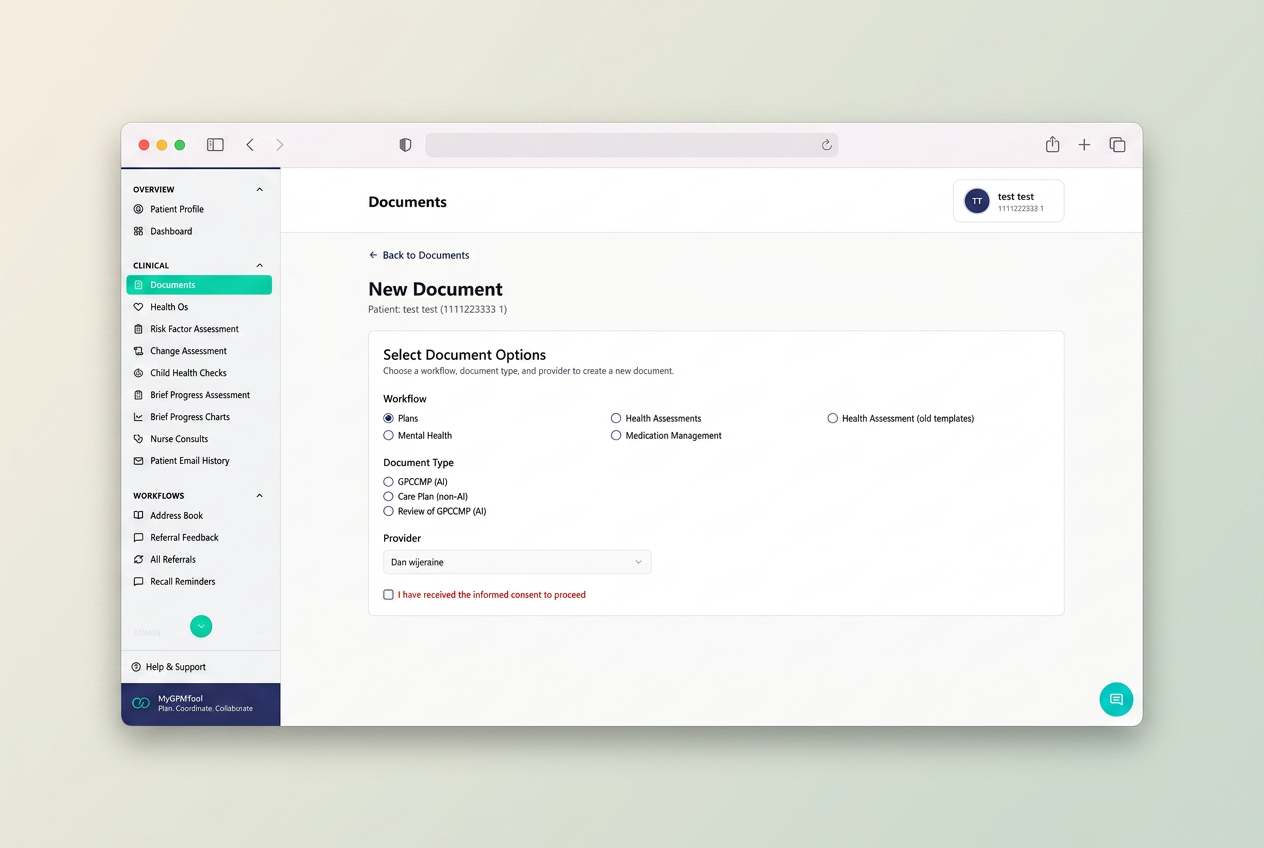
Instead of starting with a blank document or a static template, MyGPtool starts with structured, pre-defined, guideline-based content covering more than 1,000 chronic care situations.
The clinician can then adapt the information to the individual patient.
Content can be:
- Selected
- Removed
- Reorganised
- Personalised
- Updated
- Structured around the patient's needs
And it can happen in seconds.
The goal isn't to replace the clinician.
It's to remove the repetitive administrative work that comes with creating a patient-specific plan from a generic template.
From static templates to dynamic planning
Traditional template-based approach
Open template → edit manually → remove irrelevant information → add information → format → print → check
Every additional change creates another opportunity for something to be missed.
AI-assisted approach
Start with relevant content → adapt → reorganise → personalise → review
The clinician remains in control, but the system makes it easier to produce information that is appropriate for the patient.
That's an important distinction.
The technology isn't making the care decision.
It's helping the clinician create and organise the information around the care decision.
Less administration. More relevant information.
Imagine having a library of more than 1,000 chronic care situations with pre-defined, guideline-based content available when you need it.
Instead of searching through old Word documents or folders of templates, clinicians can start from relevant content and adapt it.
Need to remove a section? Remove it.
Need to change the order? Reorganise it.
Need to add additional information? Add it.
Need to make the plan more relevant to the patient? Personalise it.
No rebuilding the document from scratch.
Your care plan is also a reflection of your practice
Patients don't necessarily know what software sits behind their care.
They see what you give them.
They see whether the information appears relevant.
They notice when something doesn't apply to them.
And they notice when a document looks like it was produced for someone else.
A care plan that feels generic can undermine the sense of personalised care you're trying to provide.
A care plan that is relevant, organised and easy to understand creates a very different experience.
Because ultimately, personalisation isn't just about the patient's name at the top of the page.
It's about whether the information actually feels like it belongs to that patient.
The real cost of static care plans
The cost isn't simply:
Paper + printer + ink.
It's:
- Clinician time
- Administration
- Manual checking
- Generic information
- Poor patient engagement
- Avoidable errors
- Potential compliance questions
- Reputational risk
Those costs are easy to overlook because they don't appear on a printer invoice.
But they exist.
Care planning shouldn't be built around the template
The template should serve the care plan — not the other way around.
With MyGPtool, clinicians can access a large library of pre-defined, guideline-based content and dynamically adapt the information they need for each patient.
More relevant. More flexible. More engaging. Less manual work.
Because a patient's care plan should be about the patient — not the template.
See MyGPtool in action.
AI-assisted care planning for modern general practice — branded, patient-ready documents in minutes, not hours.
Book a demo